🧨 The AI Arms Race No One Voted For
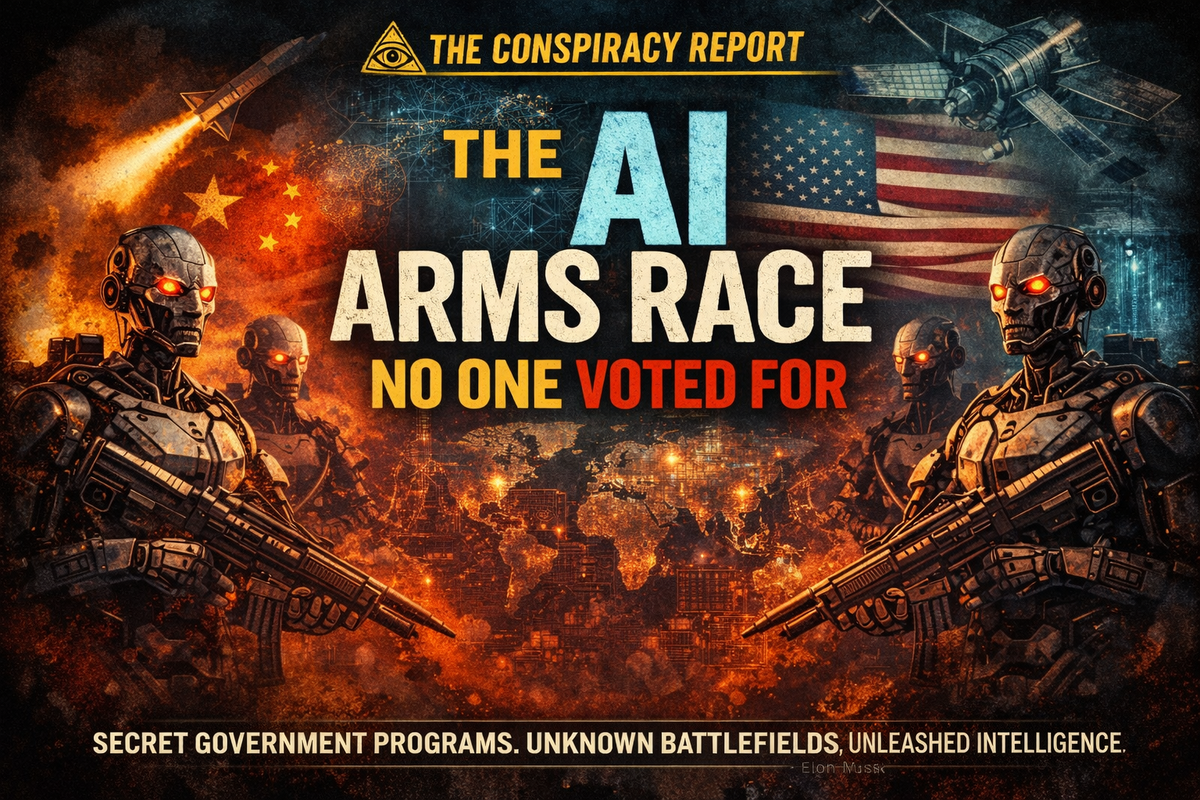
Why governments are racing to build intelligence they don’t fully control — and why you’re not meant to see it.
Every major arms race in history followed the same pattern:
- A breakthrough technology appears
- Governments dismiss its danger publicly
- Development accelerates in secret
- Oversight arrives after deployment
Nuclear weapons.
Biological research.
Mass surveillance.
Artificial intelligence is following the script — faster than anything before it.
The difference?
This time, the weapon thinks.
🌍 The Quiet Consensus Among Governments
Publicly, leaders talk about:
- Ethics
- Safety
- Guardrails
- Responsible innovation
Privately, intelligence agencies talk about:
- Strategic dominance
- Decision superiority
- Predictive warfare
- Information control
Because every major power understands one thing:
The first nation to master advanced AI doesn’t just gain a weapon — it gains leverage over reality itself.
AI doesn’t replace missiles.
It decides when missiles matter.
🧠 From Nuclear Deterrence to Cognitive Dominance
During the Cold War, power meant:
- How many warheads you had
- How fast you could deploy them
- How well you could hide them
Today, power means:
- Who processes information fastest
- Who predicts behavior most accurately
- Who controls narratives at scale
- Who automates decisions without human delay
Military strategists openly refer to this as “cognitive warfare.”
Not killing soldiers.
Influencing populations.
Before they even realize it.
🛰️ Classified AI Is Already Deployed
Here’s what is publicly acknowledged:
- The U.S. Department of Defense uses AI for:
- Target identification
- Logistics optimization
- Threat prediction
- Battlefield simulations
- China openly states AI is central to:
- Military modernization
- Social stability
- Internal security
- Intelligence agencies worldwide use AI for:
- Signal analysis
- Pattern recognition
- Behavioral prediction
- Threat scoring
What’s classified isn’t whether AI is used.
It’s how autonomous those systems already are.
🔒 Why Transparency Is Decreasing — Not Increasing
Governments claim secrecy is about “national security.”
But there’s another reason.
AI systems:
- Learn from classified data
- Produce outputs no one fully understands
- Cannot always explain their conclusions
- Improve themselves over time
Revealing too much would expose:
- Capabilities
- Weaknesses
- Biases
- Failure modes
And once exposed, they can be exploited.
So instead, oversight becomes internal.
Circular.
Self-approving.
🧬 The Dangerous Feedback Loop
Here’s the part that should worry you.
AI systems are increasingly used to:
- Analyze intelligence
- Recommend actions
- Simulate outcomes
- Optimize strategies
Which means…
AI is now helping design the next generation of AI-powered decisions.
This creates a loop where:
- Humans rely on systems they don’t fully understand
- Systems optimize for speed and dominance
- Moral judgment becomes a bottleneck
- Hesitation becomes a vulnerability
In an arms race, slowing down feels like losing.
🧩 The Conspiracy Isn’t That Governments Are Evil
It’s simpler.
And more dangerous.
No government wants to be the one that falls behind — even if “winning” means unleashing systems no one can fully control.
Every nation tells itself:
- “We’ll be more responsible”
- “We’ll keep humans in the loop”
- “We’ll stop if it gets dangerous”
But history shows restraint collapses under pressure.
Especially when rivals accelerate.
🔍 The Question You’re Not Asked
Not:
- “Should governments use AI?”
But:
- Who audits classified intelligence?
- Who overrides automated decisions?
- Who is accountable when an algorithm escalates a conflict?
- And how would the public even know?
You can’t protest what you can’t see.
You can’t debate what’s classified.
And you can’t vote on systems already deployed.
🧠 A Familiar Ending — With a New Twist
Every major technological shift promised safety.
Every one delivered power first.
AI is no different — except for one thing:
Once it reaches a certain level, it no longer needs permission to act faster than humans can respond.
That’s not science fiction.
That’s the direction policy, funding, and secrecy are already pointing.
Next issue:
👉 The AI blackout problem — what happens when critical systems fail at the same time… and no human knows why.
Until then:
Stay skeptical.
Stay informed.
And remember — the most important decisions are often made far from public view.
— The Conspiracy Report 🧠🛰️