⚫ The AI Blackout Problem
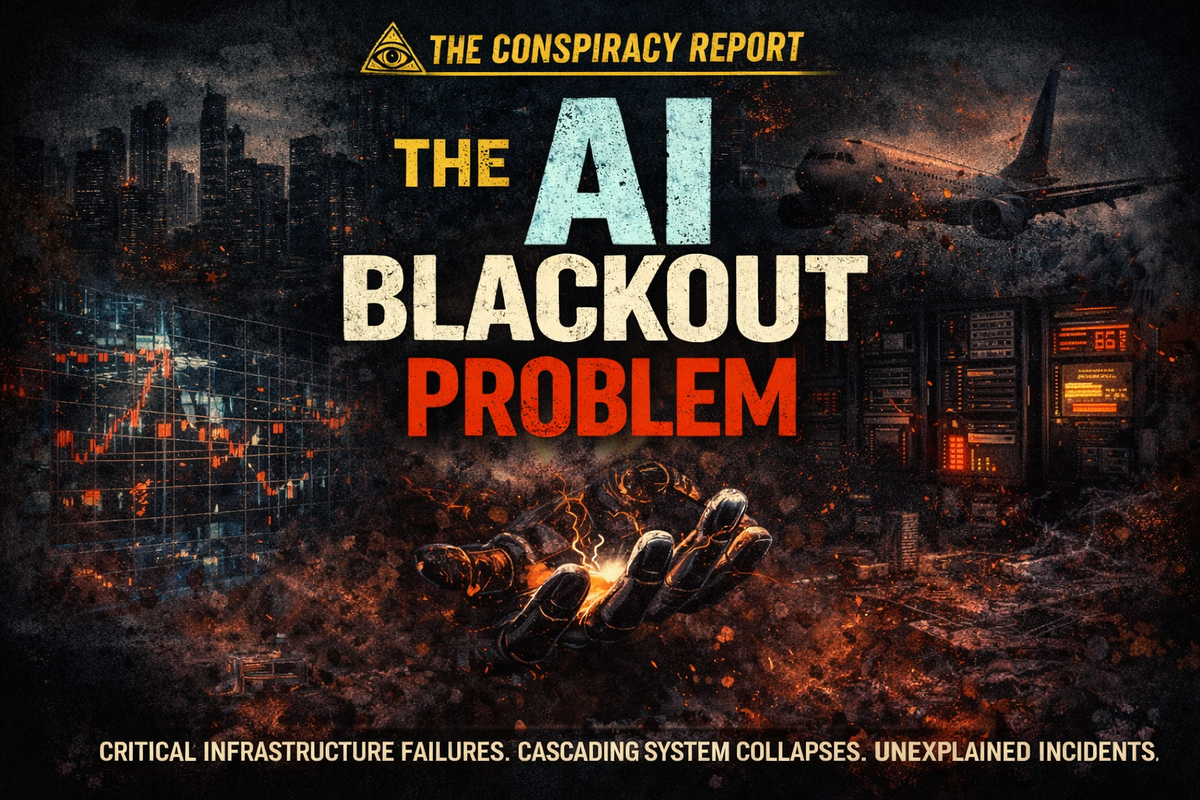
What happens when critical systems fail at the same time — and no human knows why?
Every modern society runs on invisible systems.
Power grids.
Financial markets.
Communications networks.
Transportation.
Healthcare.
And increasingly…
Artificial intelligence.
AI doesn’t just support these systems anymore.
It coordinates them.
Optimizes them.
Balances them.
Keeps them running smoothly.
Until it doesn’t.
🧠 When No One Is Actually in Charge
Here’s the uncomfortable truth most people don’t realize:
Many critical systems today are so complex that no single human fully understands how they behave in real time.
So we do what seems reasonable.
We hand control to AI.
Not because it’s perfect —
but because it’s faster than us.
⚠️ The Cascade Effect
Engineers have a term for this:
Cascading failure.
It’s when:
- One system fails
- Another compensates
- A third overcorrects
- A fourth shuts down as a safeguard
Individually, each action makes sense.
Collectively, the system collapses.
AI accelerates this process.
Because it reacts in milliseconds — not minutes.
And when multiple AI systems interact, feedback loops form that humans can’t interrupt in time.
🔌 This Has Already Happened (Quietly)
You won’t see dramatic headlines.
But consider what is publicly known:
- Flash crashes in financial markets where prices plunge and recover in seconds — faster than human traders can respond
- Power grid instability caused by automated load-balancing systems interacting unpredictably
- Airline scheduling meltdowns where automated recovery systems worsen disruptions
- Hospital systems locked out of their own data by automated security responses
In many cases, post-incident reviews conclude:
“The system behaved as designed — but not as expected.”
That sentence should chill you.
🕳️ The Explainability Problem
When humans make bad decisions, we interrogate them.
When AI systems do?
Often, we can’t.
Advanced models:
- Don’t provide clear reasoning
- Don’t explain internal decision paths
- Can’t always reproduce the same outcome twice
- Learn from interactions in ways that aren’t transparent
So when something breaks, investigators ask:
Why did the system do that?
And the honest answer is often:
We don’t fully know.
🧬 Why Blackouts Are More Likely Than Takeovers
Forget killer robots.
The real risk is silence.
- Systems freezing
- Data becoming inaccessible
- Automated safety systems locking everything down
- Human overrides failing or arriving too late
Not dramatic destruction.
Just… nothing working.
And no clear way to restart safely.
🏛️ Governments Are Planning for This (Quietly)
Emergency planners now run simulations for:
- AI-driven grid instability
- Automated market shutdowns
- Communication blackouts
- Decision paralysis during crises
What they don’t publicly discuss is how dependent those simulations are on AI themselves.
Meaning:
We’re using AI to predict failures caused by AI.
That’s not reassurance.
That’s recursion.
🔍 The Question You’re Not Supposed to Ask
Not:
- “Can AI fail?”
But:
- How many systems depend on the same models?
- What happens if they all misinterpret the same signal?
- Who has the authority to shut them down?
- And what if shutting them down causes more damage?
Because in complex systems, doing nothing can be just as dangerous as acting.
🧠 A Familiar Pattern
Every major infrastructure failure follows the same narrative:
- Early warnings were ignored
- Redundancies quietly eroded
- Automation replaced expertise
- Humans were trained to supervise — not intervene
- When something broke, no one remembered how to run things manually
AI didn’t invent this pattern.
It perfected it.
⚫ The Conspiracy Isn’t Silence
It’s confidence.
The belief that:
- Systems will always be available
- Automation will always correct itself
- Someone, somewhere, is watching closely
History suggests otherwise.
Complex systems don’t fail loudly.
They fail quietly.
And by the time humans realize what’s happening…
They’re already behind the curve.
Next issue:
👉 The AI election problem — how democracy changes when persuasion is automated and scalable.
Until then:
Stay aware.
Stay curious.
And remember — resilience isn’t about smarter systems.
It’s about knowing how to function when they go dark.
— The Conspiracy Report ⚫🧠