🗳️ The AI Election Problem
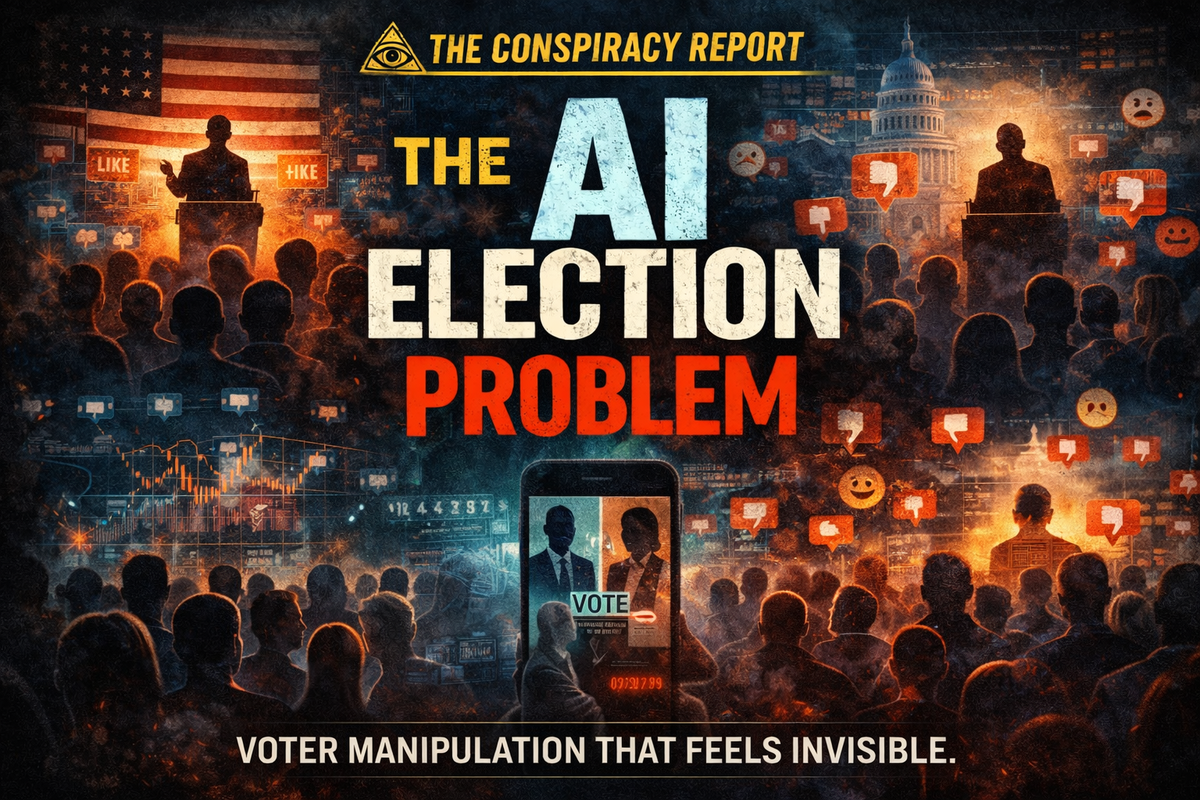
What happens to democracy when persuasion becomes automated, personalized, and invisible?
Democracy assumes something fundamental:
That voters make decisions based on shared reality.
Different opinions — yes.
Different values — absolutely.
But the same basic facts.
Artificial intelligence quietly breaks that assumption.
Not by changing votes.
But by shaping perception long before anyone reaches a ballot.
🧠 From Mass Messaging to Individual Influence
Political persuasion used to be blunt.
TV ads.
Mailers.
Billboards.
Speeches.
Everyone saw the same message — and reacted differently.
AI changed that.
Now persuasion is:
- Personalized
- Continuous
- Adaptive
- Invisible
Each person receives a slightly different version of reality, optimized for their psychology.
Not “Vote for X.”
But:
- What makes you anxious
- What makes you hopeful
- What makes you angry
- What makes you disengage
📱 The Algorithm Knows You Better Than Your Candidate Does
Modern AI systems can infer:
- Political leaning
- Emotional triggers
- Risk tolerance
- Trust thresholds
- Susceptibility to narratives
Often without you ever stating a political preference.
This isn’t speculative.
Marketing firms have done this for years.
AI simply:
- Scales it
- Automates it
- Refines it in real time
The goal isn’t persuasion alone.
It’s behavioral nudging.
Who votes.
Who stays home.
Who argues.
Who disengages entirely.
⚠️ The Most Effective Influence Leaves No Trace
Here’s the unsettling part.
The most powerful political influence:
- Doesn’t look like propaganda
- Isn’t factually false
- Doesn’t require fake news
It works by:
- Selective emphasis
- Strategic omission
- Emotional framing
- Timing
AI systems test thousands of variations simultaneously.
The ones that work spread.
The ones that don’t disappear.
No speech.
No press release.
No accountability.
🕳️ Plausible Deniability at Scale
When influence is automated, responsibility becomes blurred.
Campaigns can say:
- “We didn’t target anyone specifically”
- “The system optimized engagement”
- “The algorithm made the decision”
Foreign actors can say:
- “It was organic”
- “Just users sharing content”
- “No coordination”
AI doesn’t need instructions.
It needs objectives.
🧬 Democracy’s New Weak Point
Elections aren’t decided on voting day.
They’re decided in:
- The weeks of attention you give
- The outrage cycles you’re pulled into
- The fatigue that convinces you nothing matters
- The sense that “both sides are the same”
AI excels at amplifying emotion and exhaustion simultaneously.
Not by convincing you to choose differently.
But by convincing you to stop believing choice matters.
🏛️ Governments Are Aware — And Struggling
Election regulators now face a problem they weren’t designed to solve.
You can regulate:
- Ads
- Donations
- Campaign messaging
But how do you regulate:
- Algorithmic amplification?
- Personalized feeds?
- Emergent narratives?
- AI-generated persuasion that looks human?
By the time influence is detectable…
It’s already worked.
🔍 The Question You’re Not Supposed to Ask
Not:
- “Is AI rigging elections?”
But:
- What does a “free choice” mean when information is filtered uniquely for each person?
- Can consent exist when persuasion is invisible?
- Is democracy compatible with systems optimized for engagement over truth?
Because once perception fragments completely…
There is no shared debate to protect.
🧠 The Quiet Shift
Democracy doesn’t end with a coup.
It erodes with:
- Noise
- Confusion
- Fatigue
- Disengagement
AI doesn’t overthrow systems.
It optimizes them until they no longer resemble what they were meant to be.
No villains.
No announcement.
Just a gradual loss of agency.
Next issue:
👉 The AI truth problem — when reality itself becomes probabilistic, generated, and impossible to verify.
Until then:
Guard your attention.
Question your reactions.
And remember — the most powerful influence is the one you never notice.
— The Conspiracy Report 🗳️🧠