🧠 The AI Truth Problem
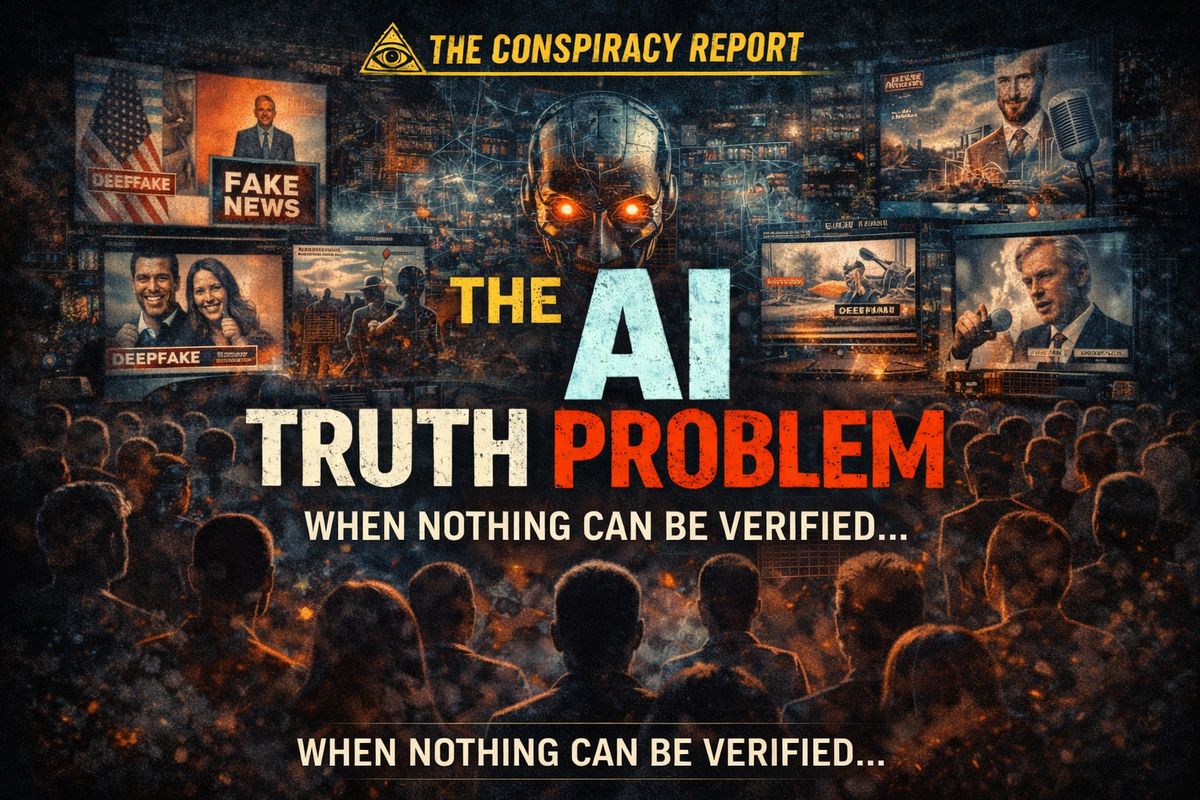
When reality itself becomes probabilistic, generated, and impossible to verify.
For most of human history, truth had friction.
It took effort to fake documents.
Skill to forge voices.
Resources to manipulate images.
That friction acted as a natural defense.
Artificial intelligence removes it.
🪞 From “Is This True?” to “Does This Feel Right?”
AI doesn’t need to convince you something is true.
It only needs to make it:
- Plausible
- Familiar
- Emotionally resonant
- Repeated often enough
In a world of AI-generated text, images, audio, and video, truth becomes statistical.
Not verified.
Not falsified.
Just… likely.
🎭 Deepfakes Were Just the Beginning
At first, the threat seemed obvious:
- Fake videos
- Synthetic voices
- Fabricated events
But the real danger isn’t a single fake.
It’s volume.
When:
- Everything can be generated
- Anything can be altered
- Anyone can be impersonated
Then nothing feels fully reliable.
And that creates a new psychological state:
Epistemic exhaustion — the point where people stop trying to determine what’s real at all.
📉 When Truth Becomes Too Expensive
Verifying reality now requires:
- Cross-checking sources
- Evaluating incentives
- Understanding AI limitations
- Assessing manipulation vectors
Most people don’t have time for that.
So instead, they rely on:
- Trusted voices
- Familiar narratives
- Emotional alignment
- “People like me”
AI exploits this perfectly.
Because it doesn’t argue.
It mirrors.
🧬 The Collapse of Shared Reality
Societies depend on shared facts:
- Elections
- Courts
- Markets
- Science
- History
AI fractures that foundation by enabling:
- Infinite versions of events
- Customized explanations
- Conflicting “evidence” for every belief
Not by enforcing one truth.
But by flooding the system with many.
🏛️ Institutions Can’t Move Fast Enough
Governments respond slowly.
Media reacts defensively.
Fact-checking becomes whack-a-mole.
By the time something is debunked:
- Attention has moved on
- Beliefs have hardened
- Corrections feel political
- Trust erodes further
In this environment, denial becomes indistinguishable from deception.
🔍 The Question You’re Not Supposed to Ask
Not:
- “Is this AI-generated?”
But:
- What happens when everything might be?
- How do you prove something real after doubt is planted?
- Who becomes the authority on truth?
- And what happens when people stop believing anyone?
Because once truth is negotiable…
Power decides what matters.
🧠 The Endgame Isn’t Control — It’s Confusion
Totalitarian systems demand belief.
AI-driven systems don’t need that.
They thrive on:
- Uncertainty
- Apathy
- Fragmentation
- Exhaustion
When people can’t tell what’s real, they disengage.
And disengaged populations are easy to manage.
⚠️ A Final Thought
The most dangerous lie isn’t a false statement.
It’s the belief that truth no longer exists.
Because once that takes hold…
Anything can replace it.
Next issue:
👉 The AI identity problem — when your face, voice, and digital self are no longer yours.
Until then:
Slow down.
Verify twice.
And remember — confusion is not accidental.
— The Conspiracy Report 🧠⚠️